Search without identifying anyone
Take one sighting of the person in the red jacket carrying a black backpack and follow their path across every camera in your venue, without ever knowing or storing who they are. Ottica's PAR Engine searches footage by appearance and description alone, on-premise, with no face and no identity required.
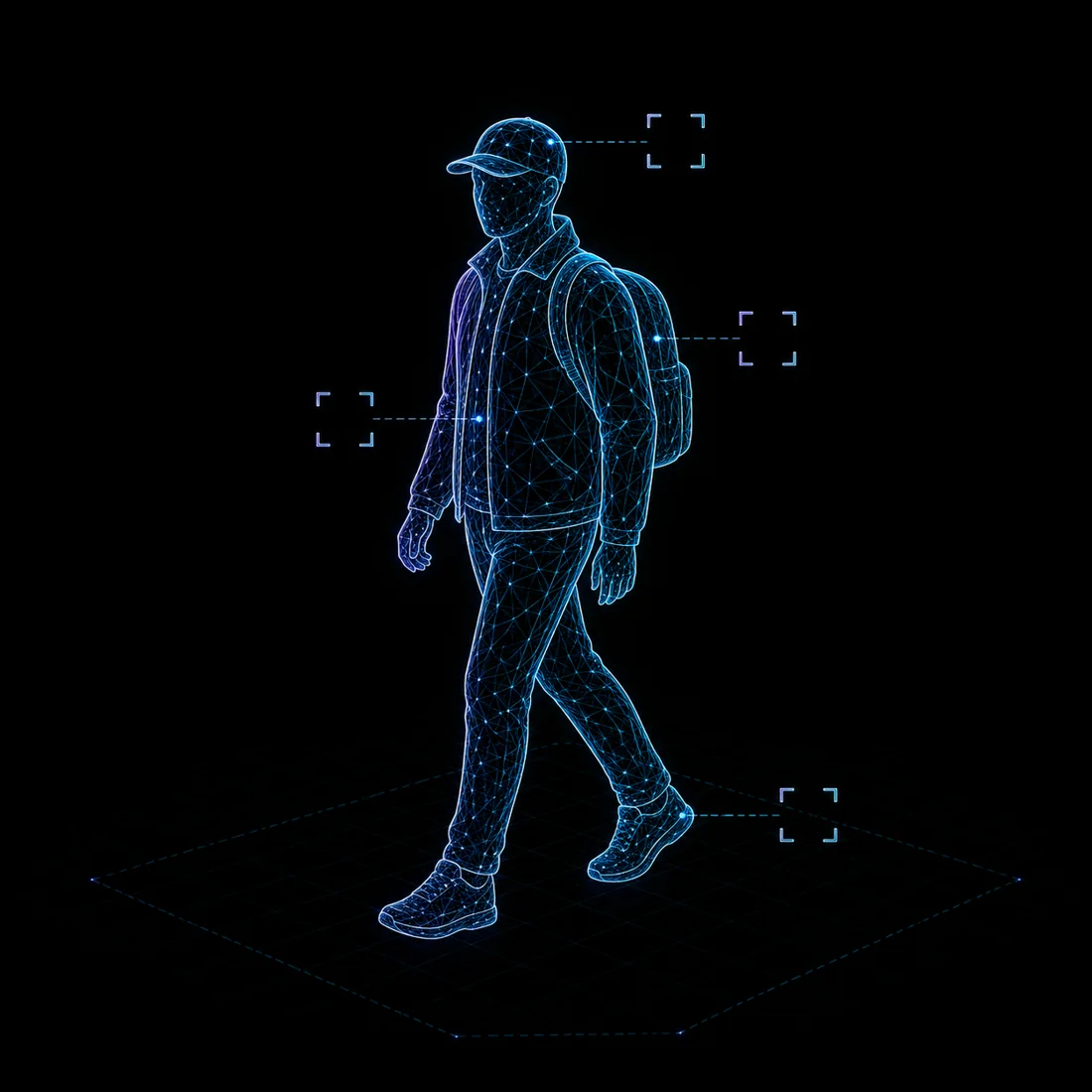
You should be able to search footage without surveilling everyone in it.
When an incident happens, the usual options are both unappealing. You either scrub hours of recordings by eye, or you reach for facial recognition and start matching people against an identity, which means you need a watchlist, a reason to identify a named person and a far heavier data footprint than the task requires. Often you have neither a name nor a watchlist, only a description from a staff member or a single sighting on one camera. Ottica's PAR Engine is built for exactly that gap. It detects every person in a frame, produces a 2048-dimension appearance signature for each one and recognises soft attributes such as clothing colour, type and length, so you can describe a person and search, or take one sighting and re-identify them across your cameras, without ever resolving who they are.
Scrubbing footage by eye does not scale
Reviewing hours of recordings across multiple cameras to find one person is slow, error-prone and rarely fast enough to matter while an incident is still unfolding.
Facial recognition is overkill when you have no identity
Matching faces against a watchlist means identifying a named individual. When all you have is a description, identity-based search collects far more sensitive data than the question requires.
Storing identity to solve a search problem is overkill
Enrolling faces to track movement collects sensitive biometric data you may have no need to hold, widening your risk for a problem that never required it.
Re-identification by appearance, not by face
The PAR Engine runs three in-house models on local GPU hardware inside your venue: a person detector, a re-identification signature and structured attribute labels. Footage and signatures never leave your site.
Detect every person in the frame
An RT-DETR person detector finds each individual in a camera image or RTSP frame and draws a bounding box, giving every later step a clean, per-person crop to work from, even in a busy scene.
A 2048-dimension appearance signature
For each person, the re-identification model produces a 2048-dimension appearance signature from how they look and what they are wearing, never from their face or identity. It is stored locally and used to match the same person across frames and cameras by appearance similarity.
Describe-and-search across your cameras
Signatures are indexed in a local Postgres and pgvector database, searched by cosine similarity, so you can take one sighting, or a clothing description and surface every camera that saw someone matching, in seconds rather than hours.
Calibrated soft attributes
For each person the engine emits structured labels: upper and lower-body clothing colour, type and length, plus accessories such as a hat or bag. Field-level accuracy is 96.25% on our internal corpus. Age band, hat and gender are treated as supporting hints, never as hard facts.
100% on-premise GPU processing
Detection, re-identification and attribute recognition all run on local GPU hardware inside your venue. Frames, signatures and the pgvector database stay on-site and no footage or appearance data is ever sent to the cloud.
No face, no identity, by design
PAR is not facial recognition and does not identify anyone. It searches and tracks by appearance alone, so you can find and follow a person without knowing or storing who they are, the lowest-data way to search footage.
What you can expect
- Find a described person across every camera in seconds, not hours
- Follow one person's path through a site by appearance, with no face required
- Repeat offenders re-identified across entrances and aisles without enrolling identity
- Locate a vulnerable person or lost child quickly from a clothing description
- Anonymous, aggregate attribute patterns for flow and dwell, with no identity retained
- Footage and appearance signatures that never leave your premises
Questions, answered.
No. Pedestrian Attribute Recognition does not use faces and does not identify anyone. It works from a person's appearance, mainly their clothing and what they are carrying, to produce a 2048-dimension appearance signature and a set of soft attribute labels. You can search for and follow a person without ever knowing or storing who they are. It is the privacy-preserving complement to facial recognition, useful precisely when you have no watchlist and no identity, only a description or a single sighting.
The engine detects every person in your footage and stores an appearance signature for each in a local database. When you provide a sighting, or describe someone by clothing, colour and accessories, the system compares signatures by appearance similarity and returns the closest matches across your cameras in seconds. Instead of scrubbing hours of recordings, your team gets a shortlist of where someone matching that description was seen.
Field-level attribute accuracy is 96.25% on our internal corpus and the model is calibrated. We are deliberately honest about which signals are firm and which are soft. Clothing colour, type and length are strong, reliable attributes. Age band, hat and gender are treated as supporting hints to help narrow a search, not as certainties and should never be relied on as hard facts about a person.
When a repeat offender works your venue, staff can describe what they are wearing, or select a single sighting on one camera and the system finds every other camera that saw a matching person and traces their path across entrances and aisles. You re-identify them by appearance alone, without ever enrolling their identity, which keeps both your response fast and your data footprint minimal.
The engine signatures and labels the people in the frames you process so they can be searched, but it does so by appearance, not identity and everything stays in a local Postgres database with pgvector inside your venue. Because no face is enrolled and no one is identified, you are not building a biometric record of who passed by, which keeps your privacy exposure to a minimum.
Ottica supplies the smart cameras and the on-site GPU server the engine runs on. All three models run on that local hardware inside your venue and nothing is sent to the cloud. Our Melbourne team, engineering on-premise computer vision in Australia since 2021, specifies and installs the cameras and compute for your site.
Search your footage without identifying a soul
Book a walkthrough with our Melbourne team and we will show you how the PAR Engine finds a described person and follows them across your cameras by appearance alone, on-premise, with no face enrolled and no identity stored.