Company21 Oct 2026 · 5 min read
Banning Notices: a proper ban, done in moments
A venue ban stands on a recorded reason, a set end date and a written notice. Ottica now generates all three in moments, logged against the person.
A venue ban stands on a recorded reason, a set end date and a written notice. Ottica now generates all three in moments, logged against the person.
The incident is over. The patron has been walked out, the room has settled and the shift has moved on. Behind the bar, someone pulls up the CCTV, finds the clearest frame of the person's face and prints it. That photo is now the ban. Maybe a name goes with it, copied off an ID or half-remembered from the door. No reason written down, no end date, nothing in the person's hand.
It works, right up until the night they walk back in and someone is out the back flicking through a folder, trying to piece together who they are, why they were banned and whether the ban even still stands. Or the day someone disputes it and the venue's entire record is a photo.
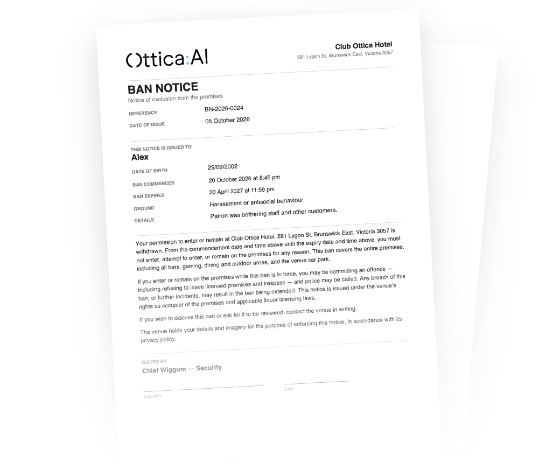
A banning notice is one piece of paperwork, but it carries the whole ban. The reason, the end date and the written copy in the person's hand all live on that single page. Get that one document right and everything downstream gets simpler: the ban is fair to the patron, enforceable at the door and easy to stand behind if anyone ever asks. The decision is still yours — the notice is just the decision, done properly.
The reason that step often didn't happen is no mystery. Writing a notice meant finding a template, working out what had to go in it and ten minutes nobody had after an incident. The photo was the system because the photo was achievable.
And the grounds were never missing either. They were in the operator's head at the moment of the decision. Recording them right then, instead of reconstructing them weeks later if someone disputes the ban, is all the difference.
Banning Notices removes the effort, which removes the excuse. Ottica takes the information already held against the person and turns it into the formal notice. No separate template, no second document, no other system. You find the patron in Ottica, generate the notice and record the grounds, the duration and who is issuing it as part of the process.
It can be printed and handed over on the spot, so the ban is not just something the person was told; it is something they were given. And if handing it over in the moment isn't practical, the notice sits ready for the next time they front up. The digital record stays in Ottica either way.
A photo behind the bar only works if someone happens to recognise the face, on the right shift, on a busy night. The photo in Ottica does not rely on that. It is checked against every person who walks through the door, automatically. The moment a banned person walks back in, staff get the match with everything attached: who it is, when they were banned, why and until when. Nobody has to recognise a face from eight months ago at the end of a double shift.
The ban and its enforcement stop being two separate problems. The same record that makes the ban proper is the record that makes it work.
This is also where the record matters most. Enforcing a ban with facial recognition means the venue is holding that person's biometric information. The recorded reason, the end date and the written notice are exactly what stand behind the venue's right to do that.
Every generated notice gets its own reference number, is timestamped and is logged against the person's profile. The incident, the decision and the paperwork stay connected, so nothing disappears into a filing cabinet once the notice has been handed over.
That gives everyone with a stake in a ban what they need. The patron knows exactly why they are banned, for how long and who made the call. The venue can look back at any ban and see the decision it made, without relying on anyone's memory. And if someone official ever asks what happened, the answer is already attached to the person: grounds, duration, issuer, date.
The decision itself always belongs to the venue. You decide who is banned, why and for how long, under your own process. Ottica's job is making sure the record of that decision is complete, specific and easy to find.
This is really what Banning Notices is about. Not adding another process, removing one. The information is already in Ottica, the details are captured as the ban is made and the notice is generated the moment it is needed. Generate. Log. Hand it over. And if the person comes back months later asking why they are banned, the same notice is right there to print again.
Banning Notices is provided as standard to every Ottica client. It is already in your dashboard, included in your licence, with nothing extra to buy. It sits alongside the rest of the compliance tools in the same place your team already works, which has always been the point of the platform: one provider covering the lot.
The best venue systems are not just about what happens in the moment. They are about what happens afterwards. What was decided? Why? Who issued it? How long does it apply? Where is the record?
Banning Notices gives venues a consistent way to answer those questions, by putting the process where the rest of the information already lives. Because when the incident is over, the ban still has to stand up.
See Banning Notices in action →
This article describes the Banning Notices feature in Ottica. Banning processes and notice requirements differ between states and venues, so make sure yours are appropriate for your circumstances.
Your best people are never at a screen. The Ottica smartwatch puts a match alert on their wrist in under two seconds — who it is, which watchlist, one glance — and it only works inside your venue.
Read insightOur wrap-up from the Australasian Gaming Expo 2026: what venues asked us at Stand 345, what landed in the demo, and why operators around the country have stopped waiting for legislation to catch up.
Read insightOn a busy floor, knowing how long a patron has really been in the gaming room is almost impossible to track by eye. How welfare tracking measures true time in the room — and why time is the trigger, not the measure.
Read insightBook a private demo and we will show you Ottica AI working on real venue scenarios — entirely on-premise, with nothing leaving your site.